
Mutual Fund Portfolio Review: How to Identify Overlap, Risk & Underperforming Investments
Introduction
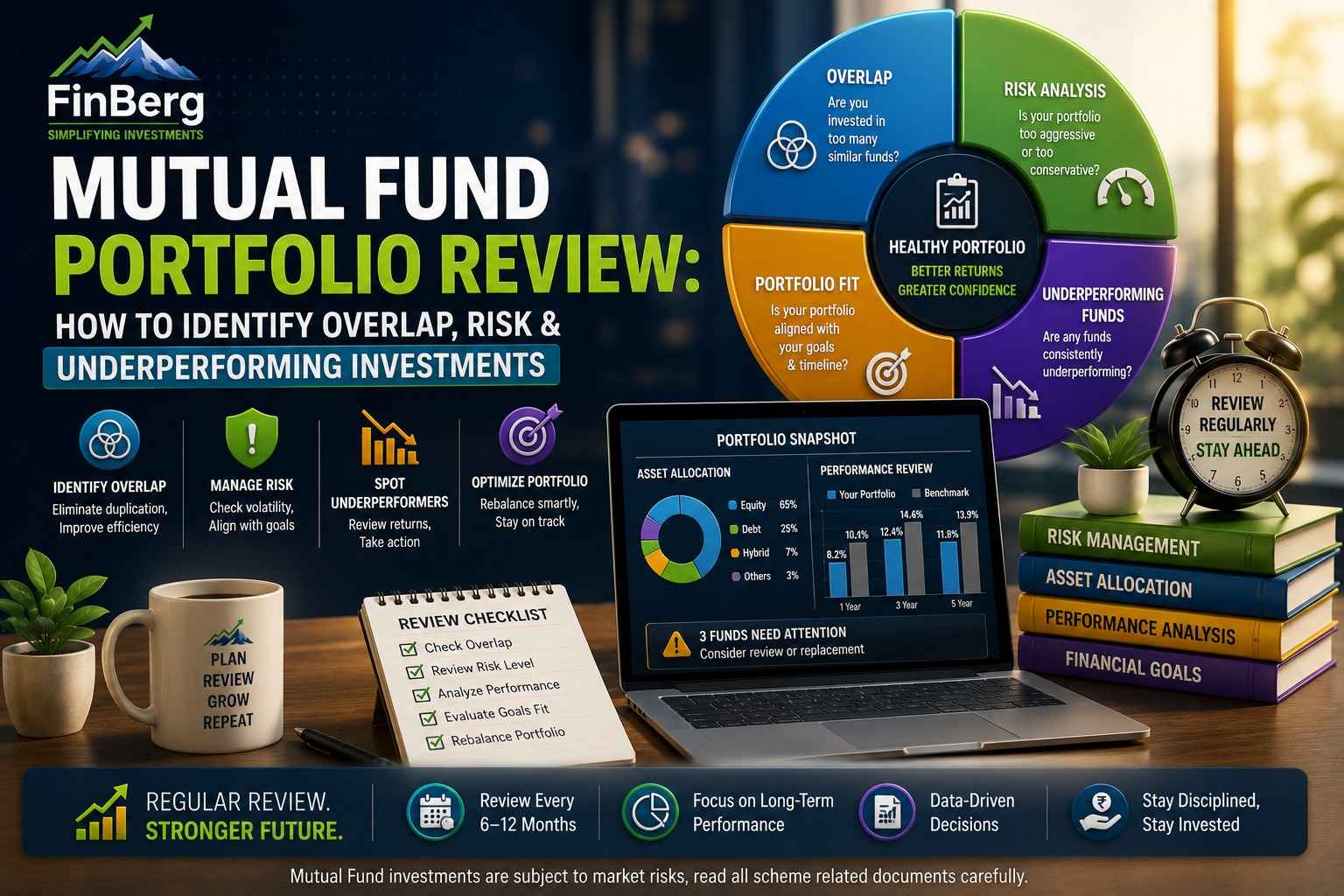
A mutual fund portfolio deserves a review that goes beyond positive returns. A proper mutual fund portfolio review looks at fund overlap, concentration, asset allocation, risk, expenses, consistency, investment objectives, time horizon and alignment, with goals. Reviewing the mutual fund portfolio as a whole helps investors spot duplication, unsuitable risk or investments that no longer match their strategy.
Review your mutual fund portfolio with expert guidance
What Is a Mutual Fund Portfolio Review?
A mutual fund portfolio review is a check of your investments to see if a mutual fund portfolio review still matches your financial goals.
A review should consider:
Fund performance
Portfolio overlap
Asset allocation
Risk level
Investment objectives
Expense ratios
Portfolio concentration
Investment horizon
Financial goals
Performance consistency
The objective is not to replace funds simply because they have recently underperformed. Instead the focus should be, on understanding whether the overall portfolio remains appropriate.
Why Individual Fund Returns Are Not Enough
Suppose you own four mutual funds and all four have delivered positive returns. At first glance, the portfolio may appear healthy.
However, those funds could:
Hold many of the same companies
Have significant exposure to one sector
Follow similar strategies
Carry more risk than expected
No longer match your financial goals
This is why a mutual fund portfolio review should evaluate how your investments work together instead of looking at each fund separately.
How to Create a Tax-Efficient Investment Strategy Without Compromising Your Financial Goals
Check Fund Overlap
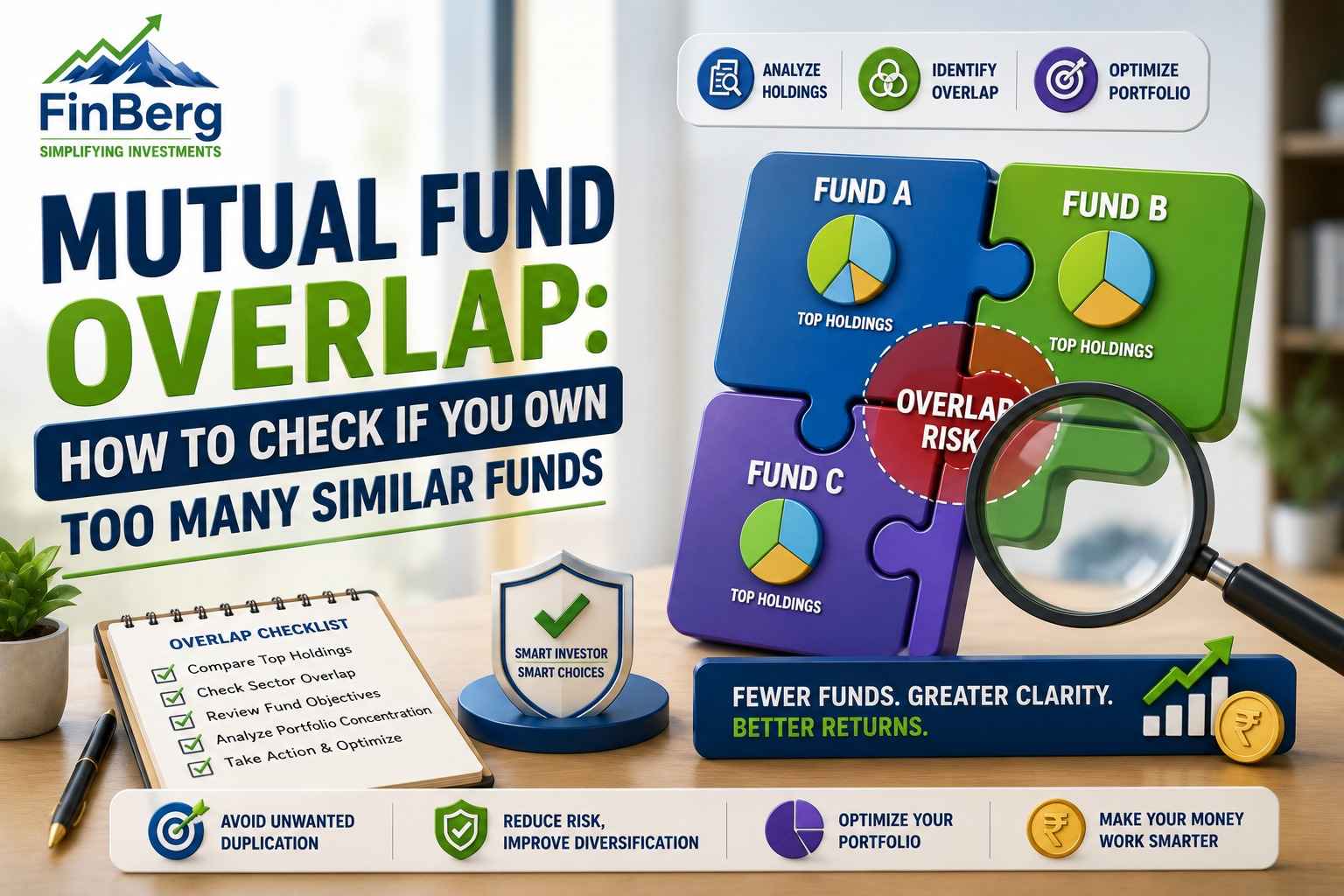
Fund overlap happens when several mutual funds buy shares in the companies or focus on the same industries.
For instance someone might have a large-cap fund, a flexi-cap fund and a diversified equity fund. Even though these are types of funds they may end up holding similar stocks. That means the investor could be getting exposure to the same companies than they realize.
How to Identify Overlap
Compare:
Top holdings
Sector allocation
Market-cap exposure
Investment style
Some overlap is normal because different fund managers may select the same companies. However, excessive overlap can reduce the diversification you expect.
Why Overlap Matters
High overlap may:
Increase concentration
Reduce effective diversification
Increase exposure to specific companies
Make the portfolio more difficult to manage
Mutual Fund Overlap: How to Check If You Own Too Many Similar Funds
Review Portfolio Concentration
Concentration is another important part of a mutual fund portfolio review.
You may own several funds but still have significant exposure to one:
Company
Sector
Market-cap category
Investment theme
For example, if several funds have large allocations to banking stocks, a decline in the financial sector could affect multiple investments at the same time.
Looking at combined exposure gives you a clearer picture of your actual portfolio risk.
Evaluate Your Asset Allocation
Asset allocation refers to how your investments are divided among different asset classes.
A portfolio may include:
Equity
Debt
Gold
Cash or liquid investments
Other suitable assets
The appropriate allocation depends on your:
Financial goals
Risk tolerance
Investment horizon
Age
Liquidity requirements
Your asset allocation should reflect when you need the money rather than simply focusing on current returns.
Pre-IPO Investing Checklist: 10 Things to Verify Before You Invest
Check Whether Your Risk Level Is Appropriate
Your risk tolerance can change as your financial circumstances change.
An investor who was comfortable with significant equity exposure at age 30 may prefer a more balanced portfolio as retirement approaches.
During a mutual fund portfolio review, consider:
Equity exposure
Market-cap exposure
Sector concentration
Portfolio volatility
Investment horizon
A fund does not necessarily become a poor investment simply because your risk profile has changed. It may simply no longer fit your current requirements.
Revisit Your Investment Objectives
Every fund should have a clear purpose within your portfolio.
Ask yourself:
Why do I own this fund?
Possible objectives include:
Retirement
Children's education
Home purchase
Wealth creation
Financial independence
If you cannot explain why a particular fund is part of your portfolio, it may deserve further evaluation.
Your investment objectives should guide your portfolio rather than allowing past returns or market trends to determine every decision.
Consider Expense Ratios and Other Costs
Investment costs can influence long-term outcomes.
During your mutual fund portfolio review, examine:
Expense ratios
Exit loads, where applicable
Transaction-related costs
Other applicable charges
However, choosing the fund with the lowest cost is not automatically the right decision.
Costs should be evaluated alongside:
Investment strategy
Portfolio quality
Risk
Consistency
Suitability
A slightly higher-cost investment may still have a role if it provides a specific benefit that fits your overall strategy.
Should You Increase Your SIP Every Year? Step-Up SIP Explained
Look at Consistency, Not Just Recent Returns
Recent returns can be useful, but they should not be the only factor used to select or replace a mutual fund.
A fund that performed extremely well during one year may not maintain the same performance in the future.
Instead, review:
Performance across different periods
Performance during market corrections
Performance relative to its benchmark
Risk-adjusted performance
Consistency
Investment strategy
The purpose of a mutual fund portfolio review is to understand the reasons behind performance rather than simply identifying the fund with the highest recent return.
Consider Your Investment Time Horizon
Your investment horizon is very important when deciding if a fund is right for you.
For instance someone saving for retirement 20 years, from now may be able to handle short‑term ups and downs.
On the hand a person who plans to buy a house in two years might need more liquidity and stability of capital.
Therefore investments should be judged based on when the money will be needed.
How to Calculate SIP Returns for Better Investment Planning
How to Identify Potentially Underperforming Investments
Underperformance does not automatically mean you should sell a fund.
Before making a decision, ask:
How long has the fund underperformed?
Is the underperformance temporary or persistent?
How has it performed against its benchmark?
How does it compare with relevant peers?
Has the fund manager changed?
Has the investment strategy changed?
Has the portfolio's risk profile changed?
A short period of weaker performance may not justify replacing an investment.
Persistent underperformance combined with changes in strategy, management, or suitability may require a deeper evaluation.
Wealth Management for High-Net-Worth Individuals: What Services Should You Expect?
Practical Mutual Fund Portfolio Review Framework
Investors can follow a simple six-step framework.
Step 1: List All Your Funds
Record:
Fund name
Category
Amount invested
Current value
Investment objective
Step 2: Check Portfolio Overlap
Compare holdings and sector allocations across your funds.
Step 3: Review Asset Allocation
Calculate your exposure to equity, debt, gold, and other assets.
Step 4: Assess Risk
Check whether your current portfolio matches your risk tolerance and investment horizon.
Step 5: Evaluate Performance and Costs
Look at long-term consistency, benchmark performance, risk, and expenses.
Step 6: Check Goal Alignment
Determine whether every fund still supports a specific financial objective.
Difference Between SIP and Mutual Fund Explained: A Complete Guide for New Investors
Example of a Portfolio Review
Consider an investor holding four equity mutual funds:
The investor may believe they have four different sources of diversification.
However, if Funds A and B hold many of the same companies and Fund D has significant exposure to one sector, the portfolio may be more concentrated than expected.
This is why a complete mutual fund portfolio review should examine the combined portfolio rather than simply evaluating individual fund returns.
When Should You Consider Switching or Restructuring?
Switching should not be based only on one year of weak performance.
A professional evaluation may be useful when:
A fund consistently deviates from its stated objective.
Persistent underperformance requires investigation.
Your financial goals have changed.
Your risk profile has changed.
Your asset allocation is no longer suitable.
Multiple funds have substantial overlap.
Your portfolio has become unnecessarily complicated.
Before switching, consider applicable taxes, exit loads, transaction costs, and the reason for making the change.
Why Past Performance Should Not Be the Only Factor
Past performance can provide useful information, but it does not guarantee future results.
Similarly, a fund with temporary underperformance should not automatically be removed from your portfolio.
A broader evaluation should consider:
Performance + Risk + Consistency + Strategy + Cost + Goal Alignment
This approach can help investors make decisions based on the overall quality and suitability of an investment rather than recent returns alone.
How Professional Portfolio Analysis Can Help
Professional portfolio analysis can reveal relationships between investments that may not be obvious when funds are reviewed individually.
For example, an analysis may identify:
Significant stock overlap
Excessive sector exposure
Unnecessary fund duplication
Asset allocation mismatches
Risk levels inconsistent with goals
Investments without a clear purpose
It can also help distinguish between temporary underperformance and more persistent concerns.
Top 20 Indian Stocks for Long-Term Investors
How Finberg Can Help With Your Portfolio Review
Finberg can help investors review their existing mutual fund portfolio in the context of their broader financial goals.
The review can consider:
Existing investments
Financial objectives
Risk profile
Asset allocation
Fund overlap
Portfolio concentration
Investment horizon
Liquidity requirements
Cost considerations
Based on this evaluation investors can decide if their portfolio should stay the same, be changed slowly or be looked at for a change.
The goal is to build a portfolio that's easy to understand, has the right mix of investments and matches the investors money situation.
Top 10 Flexi Cap Mutual Funds: What Makes Them Attractive for Long-Term Investors?
Common Mistakes to Avoid
1. Checking Returns Only
Positive returns do not automatically mean the portfolio is well structured.
2. Chasing Top Performers
Constantly switching to the latest high-performing fund can lead to inconsistent investment decisions.
3. Ignoring Overlap
Multiple funds can create significant exposure to the same companies or sectors.
4. Holding Too Many Funds
A larger number of funds does not necessarily provide better diversification.
5. Ignoring Your Time Horizon
An investment suitable for a long-term goal may not be appropriate for money needed soon.
6. Switching Without Considering Costs
Taxes, exit loads, and other applicable costs should be considered before restructuring.
Conclusion
Doing a mutual fund portfolio review can help you spot overlap, concentration changing risk levels and investments that may no longer match your goals. If focusing only on past returns look at your entire mutual fund portfolio and adjust it to fit your financial objectives, time horizon and risk profile.
Plan Your Investments With Finberg
Get professional guidance to review your portfolio and build an investment strategy aligned with your financial goals.
FAQs
1. How often should I review my mutual fund portfolio?
A periodic review, such as once or twice a year can help mutual fund portfolio see if mutual fund portfolio stays in line with mutual fund portfolios goals and risk level.
2. Does recent underperformance mean I should sell a fund?
Not necessarily. Consider the length of underperformance, benchmark performance, investment strategy, risk and the funds role in mutual fund portfolio.
3. Why is fund overlap important?
Overlap can cause multiple funds to invest in the companies or sectors potentially reducing the diversification mutual fund portfolio expected.
4. Should I own mutual funds?
There is no number. The focus should be on owning investments with clear purposes rather than simply increasing the number of funds.
5. What should I check besides returns?
Review risk, consistency, expenses, holdings, asset allocation, investment objectives, time horizon and goal alignment.
6. When should I consider restructuring my portfolio?
Consider a review when mutual fund portfolios financial goals, risk level, asset allocation or investment requirements change or when some investments no longer have a purpose.
7. Can Finberg help review my portfolio?
Yes. Finberg can assess mutual fund portfolios existing investments in relation, to mutual fund portfolios goals, risk level, asset allocation and investment horizon and help identify areas that may require further evaluation.
Powered by Froala Editor



_11zon.jpeg)