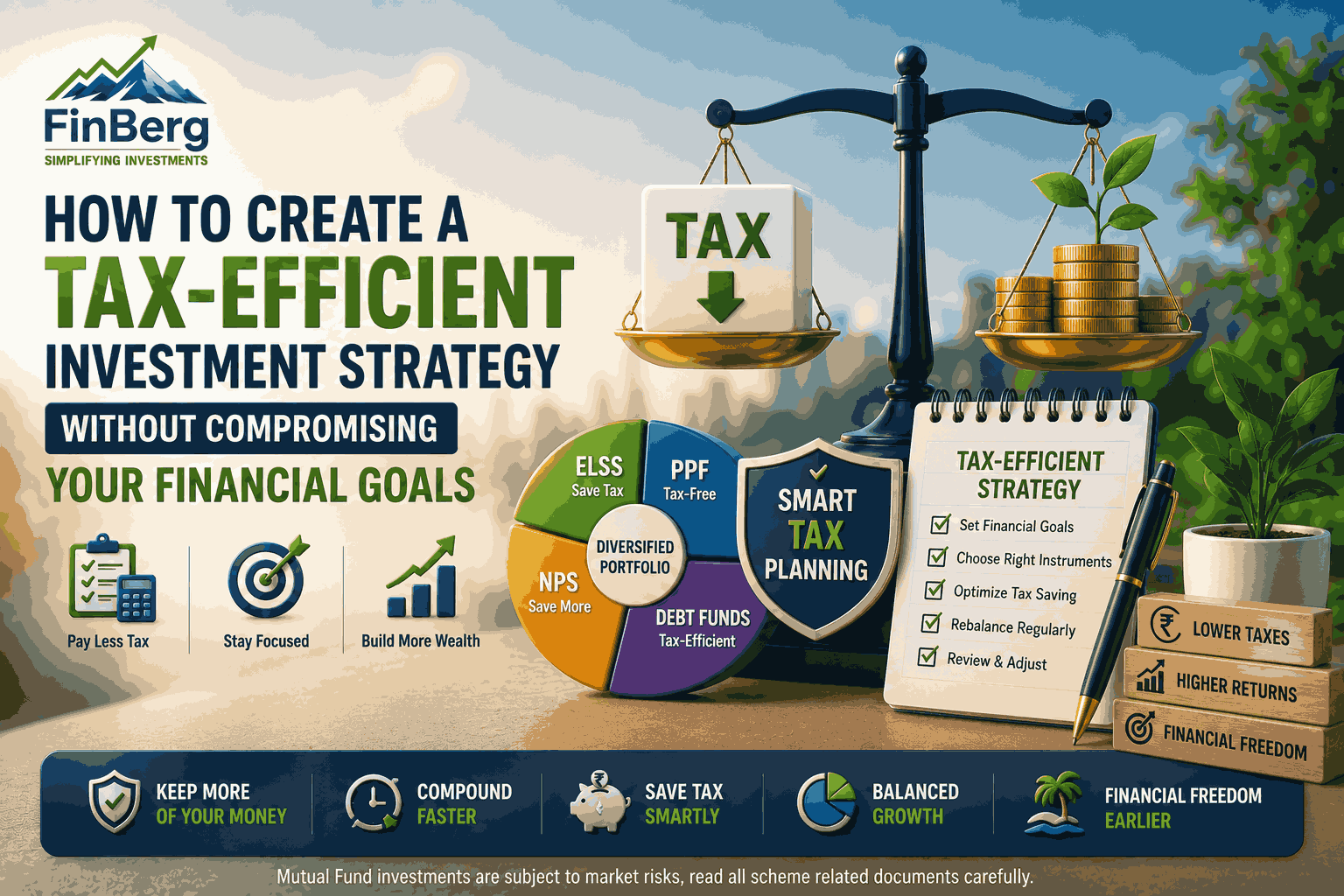
How to Create a Tax-Efficient Investment Strategy Without Compromising Your Financial Goals
Introduction
Tax can have an effect on the money you keep from an investment Picking an investment only because it gives a tax benefit can bring choices that do not match your money plans, risk comfort or need for quick cash. A tax efficient investment plan looks at things, not just tax. It checks how return you expect, how risky the investment is, how long you will hold it and what your money goals are.
For people in India this means looking at investments, under the tax rules because tax rules may change. The Income Tax Department says that its guidance is a summary. It tells taxpayers to look at the law, rules and notifications to see all the details.
Build a tax-efficient portfolio aligned with your financial goals
What Is a Tax Efficient Investment Strategy?
A tax efficient investment strategy is an approach to investing that considers the tax consequences of different investment decisions without allowing tax savings to become the only objective.
Instead of asking, "Which investment saves the most tax?" investors should ask:
Does this investment support my financial goal?
What level of risk does it involve?
When will I need the money?
How liquid is the investment?
What taxes may apply when I earn, sell, or withdraw?
What will my after-tax outcome look like?
The objective is to make investment decisions that are financially appropriate while being aware of applicable tax rules.
Why Tax Planning Should Be Part of Investment Planning
Taxation can influence the amount of money you ultimately retain from an investment.
For example, two investments may appear to offer similar pre-tax returns but have different tax treatment. The difference in taxation can affect the net outcome.
At the same time, chasing tax benefits can create other problems. An investment with a tax advantage may have a long lock-in period, limited liquidity, higher costs, or a risk profile that does not suit you.
A sensible tax efficient investment strategy therefore considers taxation as one part of the overall financial plan.
Mutual Fund Overlap: How to Check If You Own Too Many Similar Funds
Start With Your Financial Goals
Before making tax-related investment decisions, define your goals.
These could include:
Retirement
Children's education
Buying a home
Building an emergency reserve
Wealth accumulation
Business funding
Estate planning
Your goal determines your investment horizon and liquidity requirements.
For example, money required within two years should generally be assessed differently from money intended for retirement several decades away.
Pre-IPO Investing Checklist: 10 Things to Verify Before You Invest
Build a Tax-Aware Asset Allocation
Asset allocation refers to how your money is divided among different asset classes.
A simplified example could look like this:
This is only an illustration. Your actual allocation should depend on your goals, risk tolerance, investment horizon, income, and liquidity requirements.
A tax efficient investment strategy does not mean avoiding tax at all costs. It means understanding the tax implications while selecting an appropriate asset allocation.
Should You Increase Your SIP Every Year? Step-Up SIP Explained
Understand Holding Periods and Capital Gains
Holding periods can affect how investment gains are classified and taxed.
For certain assets, the distinction between short-term and long-term gains can be important. The applicable holding period and tax treatment depend on the nature of the asset and prevailing rules.
For example, the Income Tax Department's guidance identifies different holding-period rules for different categories of capital assets and notes specific treatment for listed securities and equity-oriented mutual funds.
This makes it important to understand the tax treatment before selling an investment rather than assuming that all capital gains are taxed in the same way.
Example
Suppose an investor wants to sell an investment to fund a financial goal.
Instead of considering only:
"How much profit have I made?"
the investor should also consider:
How long has the investment been held?
What type of asset is it?
What capital gains rules apply?
Will selling affect the overall portfolio?
Is there a better time or way to restructure the portfolio?
These questions can make tax planning more practical and goal-oriented.
How to Calculate SIP Returns for Better Investment Planning
Consider Tax-Saving Investments Carefully
India provides various provisions and investment options that may offer tax deductions or other tax-related benefits, subject to eligibility and the applicable tax regime.
For example, the Income Tax Department lists certain eligible payments and investments under provisions such as Section 80C.
However, tax-saving products should not automatically be considered suitable for everyone.
Before investing, consider:
Lock-in period
Risk
Expected returns
Liquidity
Costs
Your existing investments
Whether you actually need the deduction
The best tax efficient investment strategy is not necessarily the one containing the highest number of tax-saving products.
Don't Let Tax Savings Override Your Financial Goals
One of the biggest mistakes investors make is choosing an investment solely because it provides a tax benefit.
Consider a hypothetical investor who needs ₹5 lakh after three years.
They may find an investment offering a tax deduction attractive. But if the investment has a longer lock-in period or does not suit their liquidity requirement, the tax benefit may not justify the mismatch.
The correct approach is:
Goal → Time Horizon → Risk → Liquidity → Investment → Tax Impact
rather than:
Tax Benefit → Investment
This simple change in thinking can help create a more balanced tax efficient investment strategy.
Difference Between SIP and Mutual Fund Explained: A Complete Guide for New Investors
Portfolio Restructuring With Tax in Mind
Existing portfolios often contain investments accumulated over many years.
You may have:
Old mutual funds
Direct stocks
Fixed deposits
Insurance-linked investments
Bonds
Gold
Other assets
When restructuring, don't automatically sell everything that no longer fits your preferred allocation.
First evaluate the potential tax consequences.
Before Restructuring, Check:
Current market value
Original investment cost
Unrealised gain or loss
Holding period
Applicable capital gains treatment
Exit costs
Your current financial goals
This helps prevent an otherwise sensible portfolio change from creating an unexpected tax liability.
Top 20 Indian Stocks for Long-Term Investors
Tax-Loss Considerations
Where applicable under prevailing tax rules, investors may be able to use eligible capital losses to offset certain capital gains, subject to specific conditions and rules.
The Income Tax Department's tax-return guidance confirms that capital gains and losses are subject to specific reporting and treatment requirements.
However, tax-loss considerations should never be used as the sole reason to sell an investment.
A useful question is:
"Would I still sell this investment if there were no tax benefit?"
If the answer is no, reconsider whether the transaction actually supports your investment strategy.
Maintain Proper Investment Documentation
Good documentation is an important part of tax-aware investing.
Maintain records such as:
Purchase statements
Sale statements
Mutual fund statements
Contract notes
Dividend or interest records
Tax documents
Capital gains statements
Bank records
Accurate records can make it easier to calculate gains, review transactions, and complete tax reporting.
The Income Tax Department provides specific reporting requirements and return forms based on the nature of income and investments.
Top 10 Flexi Cap Mutual Funds: What Makes Them Attractive for Long-Term Investors?
Review Your Strategy Regularly
Tax rules, income, investments, and financial goals can all change.
A tax efficient investment strategy should therefore be reviewed periodically.
Review:
Asset allocation
Investment performance
Tax implications
Financial goals
Liquidity requirements
Portfolio concentration
Existing tax-saving investments
You may also need to reassess your strategy after major life events such as marriage, a career change, inheritance, retirement, or starting a business.
Example of a Tax-Aware Investment Approach
Consider two hypothetical investors.
Both investors may want to reduce unnecessary taxes, but their strategies should not be identical.
Investor A may have a longer period to tolerate market fluctuations, while Investor B may need to protect capital and maintain access to funds.
This illustrates why tax planning should be integrated with broader financial planning rather than treated as a standalone exercise.
Wealth Management for High-Net-Worth Individuals: What Services Should You Expect?
Common Mistakes to Avoid
1. Investing Only for Tax Deductions
A tax benefit does not automatically make an investment appropriate.
2. Ignoring Lock-In Periods
Don't compromise liquidity simply to obtain a deduction.
3. Forgetting Capital Gains
Selling investments can have tax consequences. Consider them before restructuring.
4. Ignoring the Overall Portfolio
Tax-efficient decisions should still maintain appropriate diversification and asset allocation.
5. Delaying Documentation
Keep investment and transaction records from the beginning.
6. Assuming Tax Rules Never Change
Tax provisions can be amended. Always verify the rules applicable to the relevant financial year.
7. Making Decisions Without Professional Advice
Complex portfolios, multiple income sources, international investments, business interests, or significant capital gains may require professional tax and financial advice.
How Finberg Can Help
Finberg can help investors integrate tax considerations into a broader investment and financial planning framework.
Rather than focusing only on tax-saving products, the process can consider:
Financial goals
Existing investments
Risk tolerance
Asset allocation
Liquidity requirements
Investment horizon
Tax considerations
Portfolio restructuring
This goal-based approach helps ensure that tax considerations support your overall financial strategy instead of driving every investment decision.
Finberg can also help investors review their portfolios periodically and identify areas where investment structure, diversification, and financial objectives may need to be reassessed.
Tax advice can be situation-specific, so investors should coordinate with qualified tax professionals where specialist tax interpretation or filing advice is required.
Important Note on Indian Tax Rules
Tax laws and interpretations can change through legislation, rules, notifications, and government decisions. The Income Tax Department's current guidance also emphasizes that online guidance may be general and not exhaustive.
Therefore, don't rely on an old tax article, calculator, or investment brochure when making a significant decision.
Before implementing a tax-sensitive transaction:
Check the rules applicable to the relevant financial year.
Review official Income Tax Department information.
Consider your tax regime and individual circumstances.
Consult a qualified tax professional when necessary.
Conclusion
A smart way to invest without paying much in taxes is not about avoiding taxes or choosing investments only for tax breaks. It is about knowing how taxes work with your money goals, how risk you can handle, how long you plan to invest, how much cash you need and how your investments are set up.
By looking at how you hold investments the profits you make ways to save on taxes by changing your investments using losses to help keep good records and check things regularly. Investors can make better choices.
The important thing is that saving taxes should help your money goals—not take the place of them. A good investment plan should still work even if tax rules change.
FAQs
1. What is a tax-efficient investment strategy?
A tax-efficient investment strategy is a way of investing where you look at how taxes will affect your money. You do not just look at taxes. You also look at risk, returns, how easy it is to get your cash back how long you want to invest and your personal financial goals.
2. Should I choose investments only because they offer tax deductions?
No you should not do that. A tax deduction is one small part of the picture. You must also think about risk how long your money is locked away liquidity, costs and if the investment actually helps you reach your goals.
3. Why is the holding period important?
The holding period matters because the amount of time you own an asset can change how the government taxes your gains. The rules change depending on what kind of asset you own and what the current tax laws say.
4. Can I restructure my portfolio to improve tax efficiency?
You might be able to do this. You have to be careful. Moving things around in your portfolio can actually cause you to owe taxes on gains or losses away. You should look at the tax costs and the reasons for making changes before you move any money.
5. Are tax rules the same for all investments?
No they are not. The way you are taxed can change based on the type of investment you choose how long you hold that investment the income it makes and different tax rules.
6. How often should I review my tax and investment strategy?
I think it is an idea to check your tax and investment strategy every so often. You should definitely review your plans if your income changes, if you make changes to your investments if your financial goals shift or if the tax laws change.
7. Can Finberg help with tax- investment planning?
Finberg can help you include tax thoughts into your financial and investment planning. However, for questions about tax laws or how to file your taxes you should always talk to a qualified tax professional.
Powered by Froala Editor