
How to Build a ₹1 Crore Investment Portfolio: Strategy, Allocation & Mistakes to Avoid
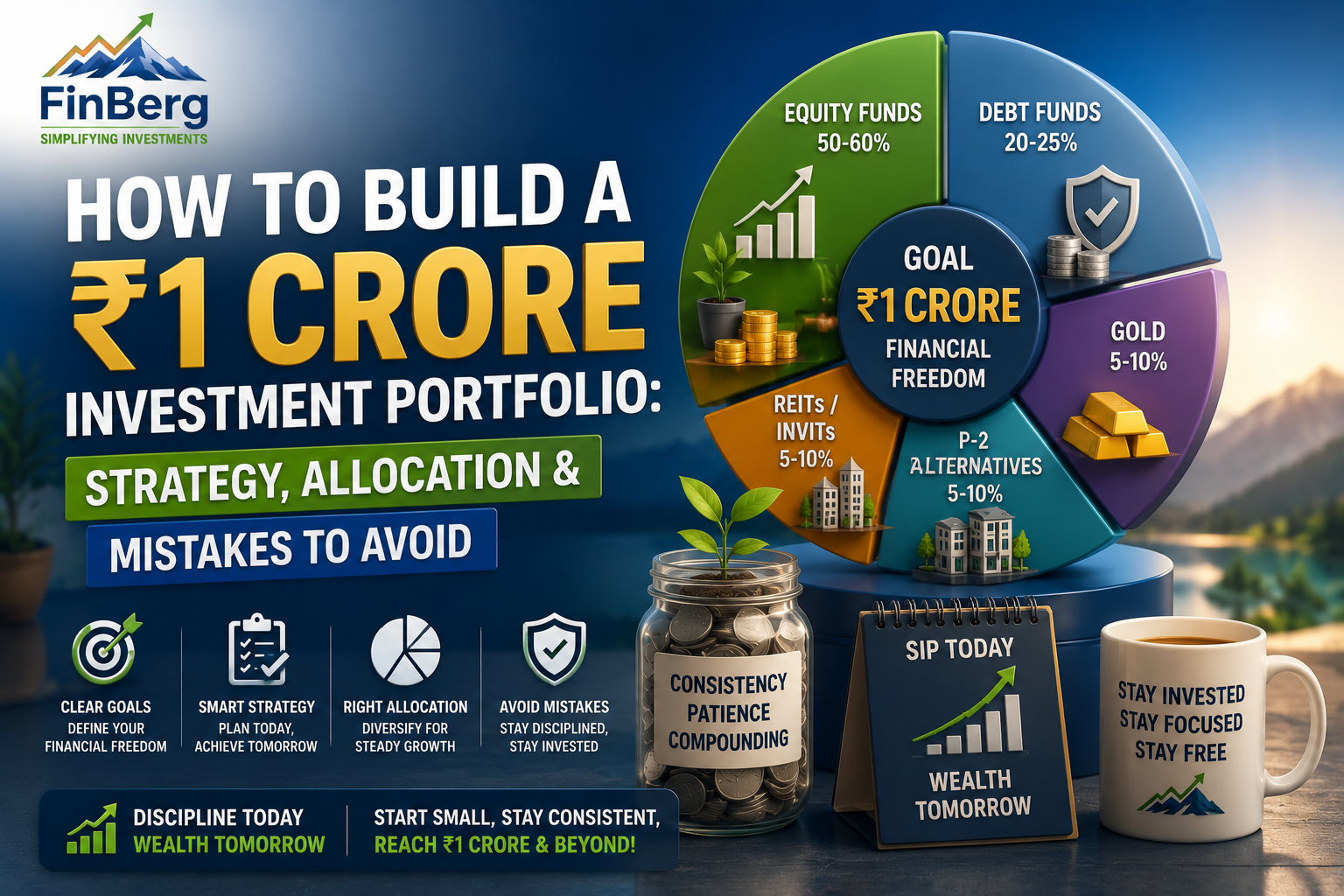
Building a ₹1 crore investment portfolio is a deal when it comes to your money but getting to that amount is not just about picking investments that make a lot of money. To do this right you need to think about what you want to achieve with your money, how you have to invest, how much money you make, how comfortable you are with the risk that you already own and how easily you can get your money when you need it.
A good ₹1 crore investment portfolio should help your money grow and be stable at the time. For some people investments, in stocks and shares might be the part while others might need to focus more on loans and assets that are easy to sell. The best way to do this depends on your situation. What is happening in the market with ₹1 crore investment portfolio.
What Is a ₹1 Crore Investment Portfolio?
A ₹1 crore investment portfolio is like a bunch of investments that're all together worth, around one crore rupees. This portfolio can have different financial things in it not just one thing that all the money is invested in.
For example, a portfolio could include:
Equity mutual funds
Direct stocks
Debt instruments
Fixed deposits
Gold
Cash or liquid investments
The main goal is not just to have ₹1 crore. We want to make a portfolio that helps us achieve our goals. At the time we have to be careful and not take too much risk, with our ₹1 crore portfolio. We need to think about what we want to do with our ₹1 crore and make a plan that works for us.
Start With Your Financial Goals
Before deciding where to invest, identify why you want to build a ₹1 crore investment portfolio.
Your objective could be:
Retirement planning
Children's education
Buying a home
Financial independence
Starting a business
Creating a long-term wealth corpus
The same ₹1 crore can have very different meanings depending on your goal.
For example a person who is getting ready to stop working in twenty years might have a mix of investments, than someone who plans to spend the money in just three years.
Mutual Fund Overlap: How to Check If You Own Too Many Similar Funds
Consider Your Investment Time Horizon
Your investment horizon is one of the most important factors when designing your portfolio.
Short-Term Goals
If you need the money within a few years, protecting capital and maintaining liquidity may be more important than pursuing aggressive growth.
Medium-Term Goals
For goals several years away, investors may consider a combination of growth-oriented and relatively stable investments.
Long-Term Goals
Investors with a long horizon may be able to accept greater short-term volatility in exchange for higher long-term growth potential.
A ₹1 crore investment portfolio should therefore be designed around when you need the money, not just how much money you want to accumulate.
Assess Your Risk Tolerance
Risk tolerance refers to your ability and willingness to handle fluctuations in investment value.
Ask yourself:
How would I react if my portfolio declined temporarily?
Do I have stable income?
How much of my wealth is already invested?
When will I need the money?
Do I have adequate emergency savings?
Someone with stable income and a long investment horizon may be comfortable with more equity exposure. Another investor may prefer a more conservative allocation.
Should You Increase Your SIP Every Year? Step-Up SIP Explained
Asset Allocation for a ₹1 Crore Portfolio
Asset allocation means dividing your investments across different asset classes.
A hypothetical portfolio could look like this:
This is only an illustration, not a recommended allocation for every investor.
A younger investor with a long investment horizon might choose a higher equity allocation, while an investor approaching retirement may prefer greater stability.
How to Calculate SIP Returns for Better Investment Planning
Equity Exposure in a ₹1 Crore Investment Portfolio
Equity can provide long-term growth potential, but it also comes with market volatility.
Mutual Funds
Equity mutual funds can provide diversification across multiple companies and sectors.
Depending on your goals and risk profile, categories may include:
Index funds
Large-cap funds
Flexi-cap funds
Mid-cap funds
Multi-cap funds
Instead of selecting funds solely because they have delivered strong recent returns, consider consistency, portfolio strategy, risk, costs, and suitability.
Direct Stocks
Direct equity can provide greater control over individual investments but requires more research.
Investors should evaluate:
Revenue and earnings
Debt
Cash flow
Competitive advantage
Management quality
Valuation
Direct stocks may not be suitable for investors who don't have the time or expertise to research companies.
Debt and Fixed-Income Investments
Debt investments can provide stability and help balance the volatility of equity.
Possible options include:
Fixed deposits
Government securities
Bonds
Debt mutual funds
Other suitable fixed-income instruments
The appropriate choice depends on factors such as credit risk, interest-rate risk, taxation, liquidity, and investment horizon.
Debt allocation can become particularly important as investors approach a financial goal.
Difference Between SIP and Mutual Fund Explained: A Complete Guide for New Investors
Don't Ignore Your Emergency Fund
An emergency fund should generally be separate from long-term investments.
It can help cover unexpected expenses such as:
Medical emergencies
Job loss
Major repairs
Family emergencies
Depending on your circumstances, an emergency reserve may cover several months of essential expenses.
Keeping this money accessible can reduce the need to sell long-term investments during an unfavorable market period.
Top 20 Indian Stocks for Long-Term Investors
Diversification: Avoid Putting Everything in One Place
Diversification is an important part of building a ₹1 crore investment portfolio.
Instead of relying heavily on:
One stock
One mutual fund
One sector
One asset class
you can spread investments across appropriate assets and sectors.
However, diversification does not mean owning dozens of investments. Too many similar mutual funds or stocks can create unnecessary complexity without providing meaningful additional diversification.
Hypothetical ₹1 Crore Portfolio Example
Consider an investor aged 35 with a stable income, a long investment horizon, and moderate-to-high risk tolerance.
A hypothetical allocation could be:
The investor could further diversify the equity portion across suitable categories rather than investing the entire amount in one fund.
This example does not predict returns. Actual performance depends on market conditions, investment selection, costs, taxes, and the investor's behavior.
Top 10 Flexi Cap Mutual Funds: What Makes Them Attractive for Long-Term Investors?
What If You Haven't Reached ₹1 Crore Yet?
You don't necessarily need ₹1 crore available today to build a ₹1 crore investment portfolio.
Regular investing can gradually build wealth.
For example, an investor might:
Start with a manageable monthly investment.
Increase contributions as income grows.
Reinvest suitable returns.
Review the portfolio periodically.
Maintain discipline through market cycles.
A step-up SIP approach can be particularly useful for salaried investors whose income increases over time.
The actual amount required to reach ₹1 crore depends on the starting investment, contribution frequency, investment horizon, and actual market performance.
Taxation Considerations
Taxes can affect your final investment outcomes, so they should be considered when constructing your portfolio.
Depending on the investment, taxation may apply to:
Capital gains
Dividends or interest
Certain withdrawals or redemptions
Tax rules can change, and different investment products may receive different tax treatment.
Therefore, avoid choosing an investment purely because of its historical return. Consider post-tax outcomes and consult a qualified tax professional when necessary.
Pre-IPO Investing Checklist: 10 Things to Verify Before You Invest
Rebalancing Your Portfolio
Asset allocation can change over time because different investments generate different returns.
For example, suppose you initially target:
60% equity
30% debt
10% other assets
If equity rises significantly, it may eventually represent a much larger percentage of the portfolio.
Rebalancing can help bring your portfolio closer to your intended allocation.
Review your portfolio periodically rather than making frequent changes based on short-term market movements.
Common Mistakes to Avoid
1. Chasing High Returns
Investments delivering strong recent returns may not continue performing at the same rate.
2. Ignoring Risk
Higher return potential generally comes with greater uncertainty. Your portfolio should match your ability to handle losses.
3. Keeping Too Little Liquidity
Don't lock all your money into long-term investments if you may need it soon.
4. Over-Diversifying
Owning too many funds or stocks can make your portfolio difficult to monitor.
5. Ignoring Taxes and Costs
Taxes, expense ratios, brokerage costs, and other charges can affect your net returns.
6. Frequently Changing Investments
Constantly switching based on market news can hurt long-term discipline.
7. Not Reviewing Your Goals
Your financial circumstances can change. Your portfolio should evolve accordingly.
Should You Pause Your SIP During a Market Crash?
How Finberg Can Help
Building a ₹1 crore investment portfolio is easier when your investments are connected to clearly defined financial goals.
Finberg can help investors evaluate their:
Financial objectives
Existing investments
Risk tolerance
Asset allocation
Liquidity requirements
Long-term investment strategy
Instead of following a one-size-fits-all portfolio, goal-based planning can help determine how much to invest, where to invest, and when to review the strategy.
For investors building wealth over many years, professional guidance can also help bring discipline to portfolio reviews, diversification, and rebalancing.
Conclusion
Building a ₹1 crore investment portfolio is something that takes time. It is not just about making one investment. The best way to do it depends on what you want to achieve with your money how you have to invest how much you earn, how much risk you are willing to take what you already own and how easily you can get your money when you need it.
You can put your money in things like shares, loans, mutual funds, direct investments and easy to sell assets depending on your situation. Do not try to get the returns or copy what someone else is doing. Instead make a portfolio that has a bit of everything so you can handle whatever happens in the market.
If you invest regularly check your portfolio from time to time put your money in the things and plan according to your goals then a ₹1 crore portfolio can be a good starting point for being financially secure, in the long run.
FAQs
1. How money should I put in every month to get ₹1 crore?
The amount of money I need to invest every month to get ₹1 crore depends on how I have to invest and how much I actually get back. If I have a time to invest I do not need to put in as much money every month to get ₹1 crore.
2. Should I put all my money for ₹1 crore in stocks?
No, not all of it. How much of my ₹1 crore portfolio should be in stocks depends on what I want to achieve how risk I can take and when I need the money for ₹1 crore.
3. How things should I invest in to get ₹1 crore?
There is no number. I should focus on spreading my money across types of investments to get ₹1 crore, rather than just buying a lot of similar things.
4. Are funds a good idea for my ₹1 crore portfolio?
Mutual funds can be helpful because they let me invest in things at once and have professionals manage my money for ₹1 crore.. I need to choose the right type of mutual fund based on what I want to achieve and how much risk I can take for ₹1 crore.
5. How often should I. Change my ₹1 crore investments?
I should check my ₹1 crore portfolio regularly to make sure it still matches my plan. I should not make changes often just because the market is going up and down. I should do it when my situation changes for ₹1 crore.
6. Is ₹1 crore money for when I retire?
It depends on how old I'm what my life is like what I spend money on how much prices are going up if I need special medical care what other money I have and how long I plan to be retired. I need to figure out how money I need for retirement based on my own situation and ₹1 crore.
7. Can Finberg help me make a plan to get ₹1 crore?
Yes Finberg can help me. Finberg can look at what I want to achieve what money I have how much risk I can take and what I need to invest in to get ₹1 crore and then help me make a plan that is just right, for me and my ₹1 crore goal.
Powered by Froala Editor