
Who Are Anchor Investors? Meaning, Benefits, and Their Role in IPOs
Introduction
Initial Public Offerings or IPOs are really popular with people who want to invest in companies when they are still growing. When people think about investing in an IPO they usually look at a lot of things like how strong the company is, what it is worth what is happening in the industry and if other people want to invest.
Understanding what anchor investors are is very helpful for people who want to invest in an IPO. This helps them figure out if the IPO is an idea and how much big investors think the company is worth.
Anchor investors are very important for IPOs because they help people trust the company and they get other investors excited before the IPO is open to the public. Anchor investors in IPOs make a difference, in getting people to invest in the company.
Understand the IPO market better with expert investment insights
What Are Anchor Investors?
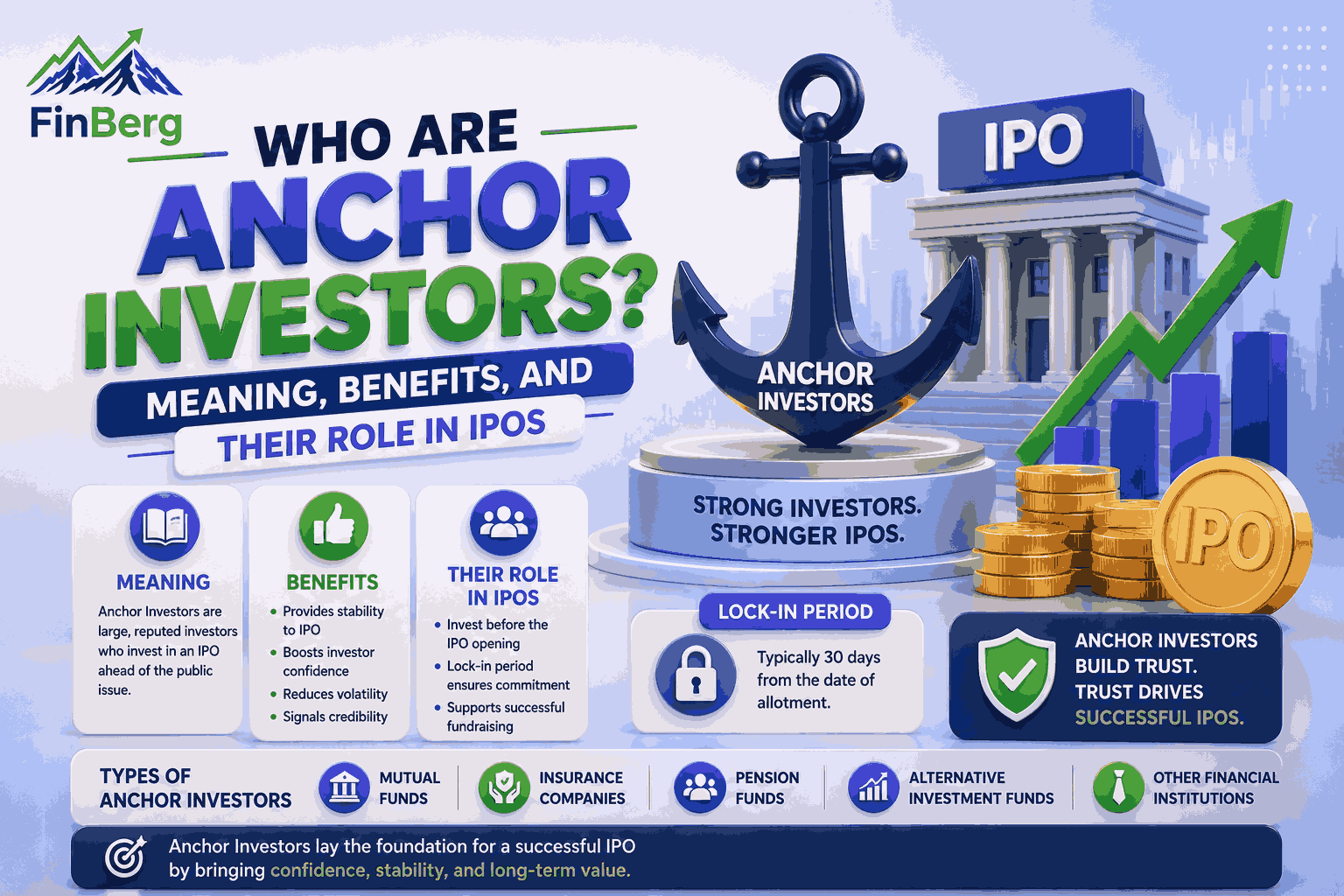
Anchor investors are qualified institutional investors who invest in an IPO before it opens for public subscription. These investors are allotted shares one day before the IPO becomes available to retail and other investors.
The primary purpose of anchor investors is to generate confidence in the public issue and provide early support to the company raising funds.
Understanding Anchor Investors Meaning
Anchor investors are institutional investors who invest before the IPO opens.
They receive share allocation before retail investors.
Their participation helps create confidence in the public issue.
Anchor investors in IPO are usually large financial institutions.
Understanding anchor investors meaning helps investors assess institutional demand.
They are subject to lock-in periods after share allotment.
Key Features of Anchor Investors
Institutional participation
Early allocation before IPO opening
Large investment commitments
Public disclosure requirements
Mandatory lock-in period
Enhanced IPO credibility
Anchor investors often act as a confidence-building mechanism that attracts additional participation from other investor categories.
₹500 SIP Can Make You a Crorepati: Best Funds to Start Today
How Anchor Investors in IPO Work
The anchor investor mechanism is designed to provide stability and confidence before an IPO launches. Companies and investment bankers identify potential institutional investors and invite them to participate in the anchor book.
Step-by-Step Anchor Investor Process
The company and merchant bankers approach institutional investors.
Investors evaluate the company and submit bids.
Anchor allocation takes place one working day before IPO opening.
Shares are allotted at the issue price.
Allocation details are disclosed publicly.
Investors remain subject to lock-in requirements.
SEBI Rules for Anchor Investors
Applicable to eligible IPOs
Allocation happens before public subscription
Investors must meet regulatory criteria
Public disclosure is mandatory
Lock-in requirements apply
Allocation follows SEBI guidelines
The process ensures transparency and allows retail investors to view the list of participating anchor investors before making investment decisions.
Types of Anchor Investors
Several categories of institutional investors participate as anchor investors depending on their investment objectives and portfolio strategies.
Major Categories of Anchor Investors
Mutual Funds
Insurance Companies
Pension Funds
Sovereign Wealth Funds
Foreign Portfolio Investors (FPIs)
Alternative Investment Funds (AIFs)
These institutions typically have extensive research teams and significant financial resources that help them evaluate investment opportunities thoroughly.
Why Institutions Participate as Anchor Investors
Early access to promising companies
Long-term wealth creation opportunities
Portfolio diversification
Exposure to growth sectors
Strategic investment opportunities
Attractive valuations
The participation of such institutions often increases confidence among other market participants.
What Is Overnight Trading? Benefits, Risks, and Who Should Consider It
Benefits of Anchor Investors in IPOs
Anchor investors provide several advantages to both companies launching IPOs and investors evaluating those offerings.
Major Benefits of Anchor Investors
Increase investor confidence in the IPO.
Improve market credibility.
Generate positive sentiment.
Attract institutional and retail participation.
Support successful subscription levels.
Enhance visibility of the public issue.
One of the biggest benefits of anchor investors in IPO is their ability to signal confidence in the company's future growth potential.
Benefits for Retail Investors
Better insight into institutional demand
Additional factor for IPO evaluation
Improved market confidence
Greater transparency
Access to allocation information
Better understanding of market sentiment
Many retail investors consider anchor investors participation as an important factor when deciding whether to apply for an IPO.
Role of Anchor Investors in IPO Success
The success of an IPO depends on several factors, including company fundamentals, pricing, market conditions, and investor demand. Anchor investors play a significant role in supporting the IPO process.
How Anchor Investors Contribute to IPO Success
Create early demand for the issue.
Improve market perception.
Increase investor confidence.
Support subscription momentum.
Strengthen company credibility.
Contribute to successful fundraising.
When respected institutions participate as anchor investors, market participants often view the IPO more favorably.
Impact on Investor Sentiment
Positive market perception
Increased subscription demand
Greater media attention
Improved institutional interest
Enhanced IPO visibility
Stronger investor confidence
Although anchor investors can influence sentiment, they should not be considered a guarantee of future performance.
These PMS Strategies Delivered Massive Returns in 5 Years
Anchor Investors vs Retail Investors
Anchor investors and retail investors participate in IPOs differently and serve different purposes within the public issue structure.
Key Differences Between Anchor and Retail Investors
What Retail Investors Should Learn
Analyze institutional participation carefully.
Study company fundamentals independently.
Avoid blindly following anchor investors.
Understand valuation metrics.
Assess risks objectively.
Make informed decisions.
Retail investors should use anchor participation as one factor among many when evaluating an IPO.
Exchange Traded Funds (ETF): Meaning, Benefits, Risks & Smart Investment Strategy
Should Retail Investors Follow Anchor Investors?
Many investors believe that strong anchor participation automatically means an IPO will perform well. However, that assumption can be misleading.
Reasons Investors Monitor Anchor Participation
Indicates institutional confidence.
Provides insight into demand.
Signals market interest.
Supports IPO analysis.
Reflects professional research.
Adds credibility to the issue.
Why Independent Research Is Still Necessary
Institutional investors can make mistakes.
Market conditions can change.
Valuation remains important.
Listing gains are never guaranteed.
Every IPO carries risks.
Long-term performance depends on business quality.
While anchor investors can provide useful insights, investors should always conduct their own research before investing.
Why Mutual Funds Are Popular in India: Benefits, Risks and Long Term Potential
Examples of Well-Known Anchor Investors
Several large institutions frequently appear in IPO anchor books due to their experience and investment capabilities.
Prominent Anchor Investors
SBI Mutual Fund
HDFC Mutual Fund
ICICI Prudential Mutual Fund
Nippon India Mutual Fund
LIC
Global Sovereign Wealth Funds
These institutions are known for conducting detailed research before investing.
Characteristics of Successful Institutional Investors
Strong research capabilities
Experienced investment teams
Long-term investment focus
Diversified portfolios
Risk management expertise
Disciplined investment processes
The participation of reputable institutions often attracts greater market attention.
7 Mutual Funds Giving Better Returns Than FD in 2026
Key Things Investors Should Check Before Applying for an IPO
Anchor participation should never be the sole basis for an investment decision.
Important IPO Evaluation Criteria
Company financial performance.
Revenue growth trends.
Profitability and margins.
Industry outlook.
Valuation compared to peers.
Management quality.
Additional Factors to Analyze
Anchor investor participation
Grey market trends
Risk disclosures
Debt levels
Competitive position
Future growth plans
A comprehensive analysis helps investors make better decisions and avoid unnecessary risks.
Common Misconceptions About Anchor Investors
Many investors misunderstand the role of anchor investors in IPOs.
Myths Investors Should Avoid
Every IPO with anchor investors will succeed.
Anchor participation guarantees listing gains.
Retail investors should blindly follow institutions.
Strong subscriptions always mean profits.
Institutional investors never make mistakes.
IPOs with anchor participation are risk-free.
Reality Investors Must Understand
Every IPO involves risk.
Fundamentals remain important.
Market conditions matter.
Valuation impacts returns.
Research is essential.
Long-term performance varies.
Understanding these realities can help investors make more balanced investment decisions.
How to Start a Mutual Fund Portfolio with a Small Budget
Why Anchor Investors Matter in Modern IPO Markets
The role of anchor investors has become increasingly important as IPO markets continue to grow and attract more participants.
Reasons Anchor Investors Are Important
Improve market confidence.
Enhance IPO transparency.
Support price discovery.
Attract institutional participation.
Strengthen market credibility.
Improve fundraising success.
Long-Term Impact on Capital Markets
Better investor confidence
Improved market participation
Greater transparency
Enhanced credibility
Stronger institutional involvement
More efficient capital markets
Anchor investors contribute significantly to the development of healthy and transparent public markets.
The Ultimate Guide to ETF Investing in India: Types, Strategies & Best Picks
Conclusion
Anchor investors play a critical role in modern IPO markets by providing early support, institutional confidence, and credibility to public offerings. Understanding anchor investors meaning helps investors evaluate demand, market sentiment, and institutional participation more effectively.
While anchor investors in IPO can positively influence subscription levels and investor confidence, they should not be the sole factor driving investment decisions.
Make smarter IPO investment decisions with expert market insights from Finberg. Stay informed, analyze opportunities with confidence, and build a stronger investment portfolio for the future.
FAQs
What are anchor investors?
Anchor investors are institutional investors who receive share allocations before an IPO opens for public subscription.
Why do companies invite institutional investors before an IPO?
Their participation helps improve credibility, confidence, and demand for the issue.
Who can participate in the anchor investor category?
Mutual funds, insurance companies, pension funds, sovereign wealth funds, FPIs, and AIFs can participate.
Do institutional allocations guarantee successful listings?
No, listing performance depends on market conditions, valuation, and company fundamentals.
How are shares allocated before the IPO opens?
Shares are allotted through a separate anchor allocation process conducted before public subscription begins.
Can individual investors participate in this category?
No, this category is reserved for eligible institutional investors.
Why do retail investors track institutional participation?
It provides insight into professional investor interest and market sentiment.
Are there lock-in requirements for institutional investors?
Yes, shares allotted under this category are subject to regulatory lock-in requirements.
Should investors rely only on institutional participation before applying?
No, investors should also analyze company financials, valuation, risks, and growth prospects.
What factors are most important when evaluating an IPO?
Financial performance, valuation, business model, industry outlook, management quality, and risk factors are among the most important considerations.
Powered by Froala Editor