
Equity vs Shares: Meaning, Features, and Key Differences Explained
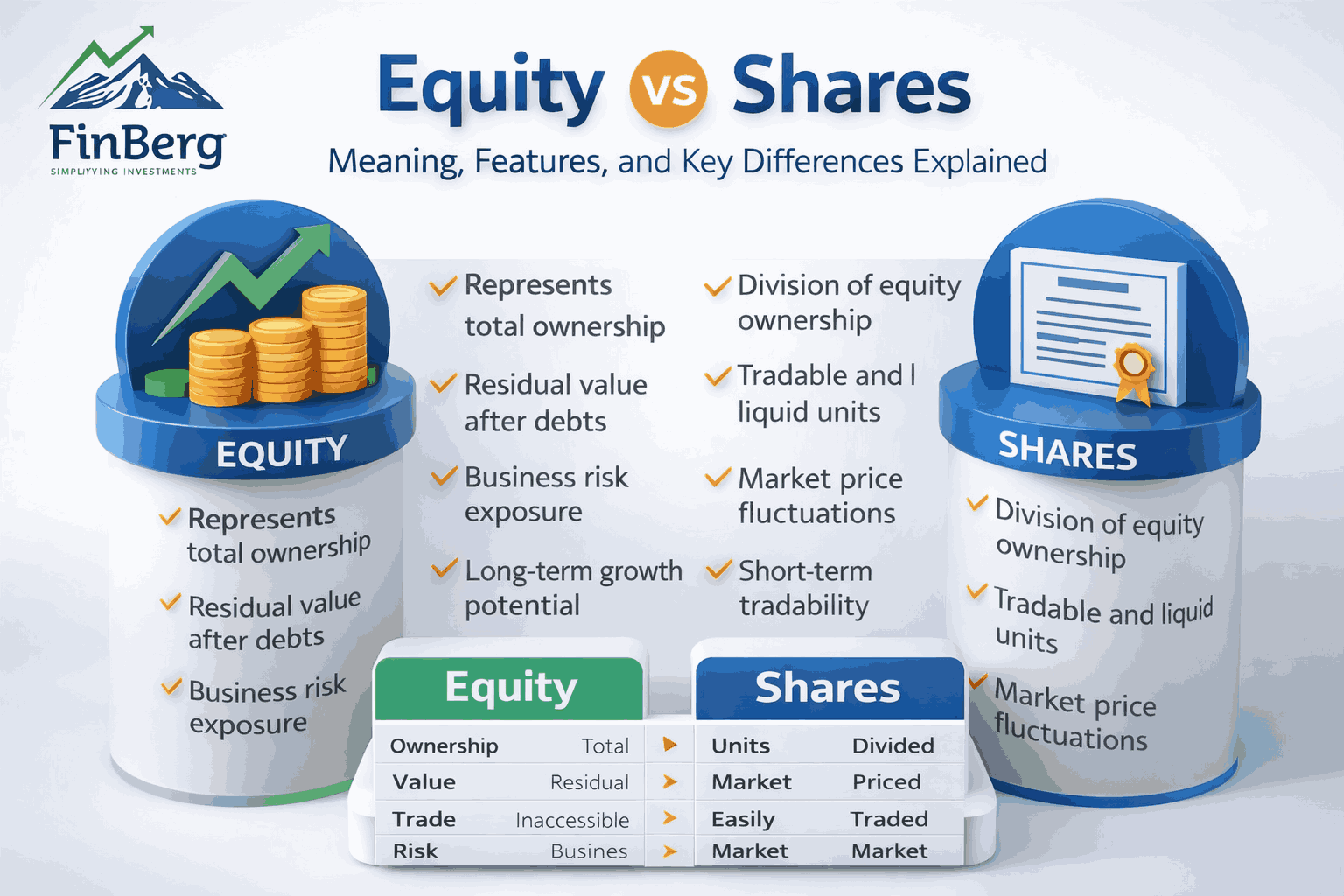
For many investors, especially beginners, the stock market can feel overwhelming because of confusing terminology. One of the most common sources of confusion is equity vs shares. These terms are often used interchangeably in conversations, news, and even by experienced investors, yet they carry different meanings depending on context.
Understanding equity vs shares meaning is essential for anyone who wants to invest confidently. When investors clearly understand the difference between equity and shares, they are better equipped to evaluate ownership, risk, and long-term return potential. This clarity helps avoid costly mistakes and builds a strong foundation for financial decision-making.
Explore Finberg’s equity services for smarter equity investing
Understanding Equity and Shares
Equity and shares are closely related concepts, but they represent ownership from different perspectives. One focuses on value and ownership, while the other focuses on division and tradability.
What equity means in investing
Equity refers to the ownership interest that shareholders have in a company. It represents the portion of a company’s assets that belong to shareholders after all liabilities are paid.
Equity reflects ownership in the business
It represents the residual value after debts
Equity grows as the company performs well
It plays a major role in long-term wealth creation
Equity holders benefit from both growth and profitability
From an investor’s point of view, equity is about long-term participation in a company’s success rather than short-term price movements.
What shares represent
Shares are the units into which a company’s equity is divided. When investors buy shares, they are buying a portion of the company’s equity.
• Shares act as measurable ownership units
• They are traded on stock exchanges
• Share prices fluctuate daily based on demand and supply
• Shares provide liquidity to equity ownership
• They allow investors of all sizes to participate
Shares make equity accessible and tradable, which is why they are central to stock market activity.
Equity vs Shares Meaning Explained Clearly
To fully understand equity vs shares meaning, it helps to look at how these terms function together rather than separately.
How equity and shares are interconnected
Equity represents total ownership, while shares are the method used to distribute that ownership.
Equity is the broader concept of ownership
Shares divide equity into smaller parts
Buying shares gives the investor equity ownership
The equity and shares difference lies in scope versus measurement
Equity shows value, shares show quantity
Read More: What is PMS in Stock Market A Complete Guide in 2025
Why investors use the terms interchangeably
The confusion around equity vs shares meaning arises because both terms refer to ownership, just from different angles.
• Market discussions focus on share trading
• Equity is implied rather than explicitly stated
• Informal usage ignores technical distinctions
• Media and casual investors blur definitions
Equity vs Shares: Key Conceptual Differences
Although related, equity and shares differ in how they describe ownership and financial rights.
Ownership perspective
Equity defines the ownership relationship, while shares define how that ownership is divided.
Equity represents total ownership in the company
Shares represent ownership portions
Voting rights stem from equity ownership
Dividend rights are linked to shares
Control increases with higher equity stake
Financial and legal interpretation
The equity and shares difference becomes clearer when viewed from accounting and legal perspectives.
• Equity appears on the balance sheet
• Shares appear in trading and ownership records
• Equity measures net company value
• Shares determine investor participation
Read More: Difference Between SIP and Mutual Fund Explained: A Complete Guide for New Investors
Difference Between Equity and Shares in Practice
The difference between equity and shares is not just theoretical; it affects how companies raise money and how investors earn returns.
Role in company structure
Companies issue shares to raise equity capital, which is then used for growth and operations.
Equity reflects company valuation
Shares divide ownership among investors
Issuing shares increases equity capital
Equity and shares difference affects dilution
Ownership percentage changes with share issuance
Impact on investors
The difference between equity and shares influences both risk and reward for investors.
• Shareholders gain exposure to equity growth
• Share prices fluctuate daily
• Equity value changes with business performance
• Ownership percentage affects voting power
• Long-term returns depend on equity growth
Features of Equity
Equity has several defining features that attract long-term investors.
Core characteristics of equity
• Represents ownership interest
• Residual claim on company assets
• Linked to long-term growth
• Subject to business risk
• Reflects company profitability and value
Benefits of holding equity
Holding equity allows investors to participate in a company’s long-term success through appreciation and potential dividends.
Read More: How to Buy and Sell Unlisted Shares in India: A Step-by-Step Investor’s Guide
Features of Shares
Shares act as the vehicle through which equity is bought and sold.
Core characteristics of shares
Divisible ownership units
Easily tradable in markets
Market-determined pricing
High liquidity compared to direct ownership
Transparent pricing mechanisms
Advantages of investing in shares
• Lower capital requirement to invest
• Flexibility to buy or sell
• Easy portfolio diversification
• Access to listed companies
Equity vs Shares Meaning in the Stock Market
The stock market highlights the functional difference between equity and shares very clearly.
How equity appears in financial statements
Equity is recorded as shareholder equity on the balance sheet.
Shows company net worth
Includes retained earnings
Reflects financial strength
Used in valuation analysis
How shares trade in markets
Shares are traded daily and reflect investor sentiment.
• Prices respond to earnings and news
• Influenced by supply and demand
• Enable liquidity for equity investors
• Serve as a price discovery mechanism
Read More: Comparing the Best PMS Companies in India: Performance, Fees, and Services Explained
Equity and Shares Difference for Beginners
Beginners often misunderstand equity vs shares meaning due to overlapping usage.
Common misunderstandings
• Assuming equity and shares are identical
• Confusing share price with equity value
• Ignoring ownership implications
• Overlooking balance sheet equity
How to remember the difference
Equity means ownership
Shares are units of that ownership
Buying shares equals owning equity
Equity shows value, shares show division
Types of Equity and Shares
Equity and shares come in different forms, each with unique features.
Equity types
• Common equity
• Preference equity
Types of shares
• Equity shares
• Preference shares
Learn More: Equity Fund Investment vs. Mutual Fund: Which Is Better for 2025?
Equity vs Shares: Risk and Return Comparison
Risk and return are central to understanding equity vs shares.
Risk exposure
Equity investments are exposed to business performance and market conditions.
• Business risk affects equity value
• Share prices reflect market volatility
• Higher risk can mean higher returns
Return potential
Returns from equity come in two main forms.
Capital appreciation through share price growth
Dividends from company profits
Long-term compounding benefits
Wealth creation through sustained growth
Equity vs Shares: Taxation and Regulations
Taxation and regulation also highlight the equity and shares difference.
Tax treatment of equity investments
Equity investments are subject to capital gains tax based on holding period.
Regulatory aspects of shares
• Shares are regulated by market authorities
• Disclosure and compliance rules apply
• Investor protection mechanisms exist
Equity vs Shares in Long-Term Investing
Both equity and shares are essential for long-term investment strategies.
Role in wealth creation
Equity investments support long-term wealth creation through business growth and compounding.
Portfolio diversification
Shares allow diversification across sectors, industries, and companies.
Read More: How to Choose the Best Pre-IPO Investment Platform: A Beginner’s Guide
Equity vs Shares Comparison Table
How to Choose Between Equity and Shares
Choosing between equity and shares requires clarity of goals and understanding.
Factors investors should consider
Investment horizon
Risk tolerance
Knowledge level
Capital availability
Financial goals
Role of professional guidance
Professional guidance helps investors understand equity vs shares meaning and apply concepts correctly.
Common Mistakes Investors Make
Mistakes often arise from misunderstanding equity and shares difference.
Misinterpreting equity vs shares meaning
• Treating share price as true value
• Ignoring ownership percentage
• Overlooking long-term perspective
Poor investment decisions
Emotional trading
Short-term focus
Lack of research
Ignoring fundamentals
Conclusion
Understanding equity vs shares is essential for anyone participating in the stock market. Shares are the units that investors trade, while equity represents the actual ownership and value in a company. Clear understanding of equity vs shares meaning removes confusion and supports smarter decision-making.
By learning the difference between equity and shares and applying that knowledge practically, investors can manage risk better, evaluate opportunities accurately, and build long-term wealth with confidence.
Get expert investment guidance- contact Finberg today
Frequently Asked Questions
1. What is the difference between equity and shares?
Equity represents ownership, while shares are the units dividing that ownership.
2. Is equity the same as shares in investing?
They are related but not identical, which is why equity vs shares meaning matters.
3. Why is equity vs shares meaning confusing for investors?
Because the terms are often used interchangeably in everyday discussions.
4. Are equity shares different from other shares?
Yes, equity shares provide ownership and growth participation.
5. How does equity represent ownership?
Equity reflects the net value belonging to shareholders.
6. Can investors buy equity without buying shares?
In public markets, equity ownership is acquired through shares.
7. Which is better for long-term investing?
Equity investments through shares are effective for long-term growth.
8. How does equity and shares difference affect returns?
Returns depend on business performance and market valuation.
9. Are shares riskier than equity?
Shares reflect market volatility, while equity reflects business risk.
10. How should beginners understand equity vs shares?
By remembering that equity is ownership and shares are units of ownership.
Powered by Froala Editor